
Is Your Mains Water Supply Adequate?
A Guide to Flow & Pressure Tests
When you’re designing a new development or a major refurbishment, assuming your mains water supply is “good enough” is a costly gamble. A mains water flow and pressure test is often the first hard piece of evidence you need to correctly size booster sets, water storage, and fire safety systems.
For UK M&E engineers and developers, proving that the incoming mains supply is adequate is now a standard part of due diligence. This guide explains what an adequacy test is, why it matters, and how the results inform critical design decisions.
What is a Mains Water Flow and Pressure Test?
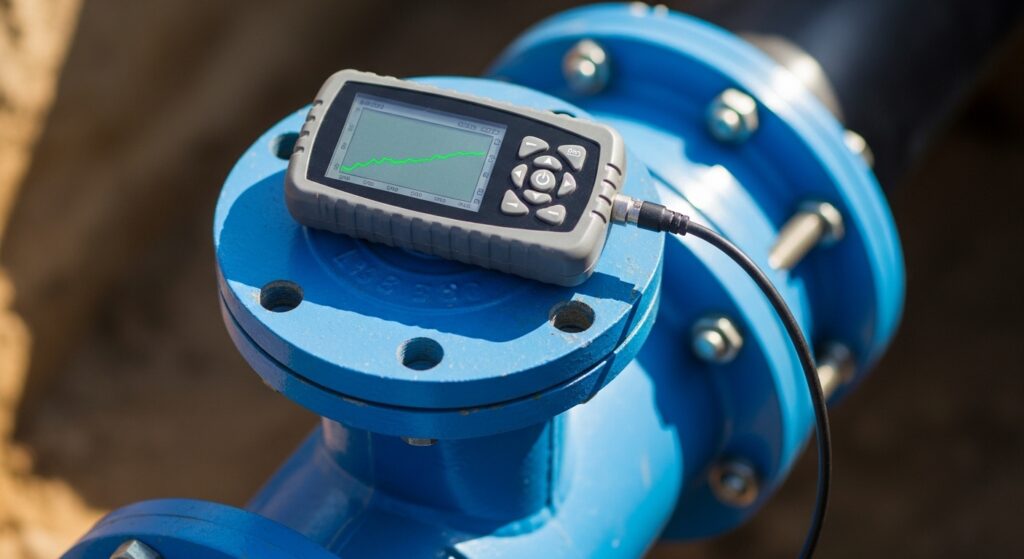
A mains water flow and pressure test (often called a flow and pressure survey) is a controlled assessment of your existing or newly installed mains connection. Instead of relying on theoretical figures from the water undertaker, this test measures the true performance of the supply under real demand conditions.
Our technicians record three critical data points:
- Static Pressure: The pressure at the point of connection when no water is flowing.
- Achievable Flow: The volume of water available at different draw-off rates.
- Dynamic Pressure: How significantly the pressure drops as the flow rate increases.
The outcome is a comprehensive report that gives your design team a realistic picture of the supply’s capabilities, which is essential data for accurate hydraulic calculations.
Why Adequacy Matters for UK Developments
For many projects, the incoming mains supply is the limiting factor. Even the best booster set cannot create water that isn’t there. If the supply is undersized or unstable, it can lead to:
- Poor User Experience: Insufficient pressure on upper floors, leading to complaints about shower performance.
- Equipment Failure: Booster sets running at maximum capacity to compensate for low inlet pressure, shortening their lifespan.
- Safety Risks: Fire mains, sprinklers, or risers failing to achieve the required design flows at critical outlets.
By commissioning a project-specific adequacy test, you gain a defensible basis for your design decisions, supporting value engineering and avoiding expensive remedial works later.
Project in Focus: Alconbury Weald
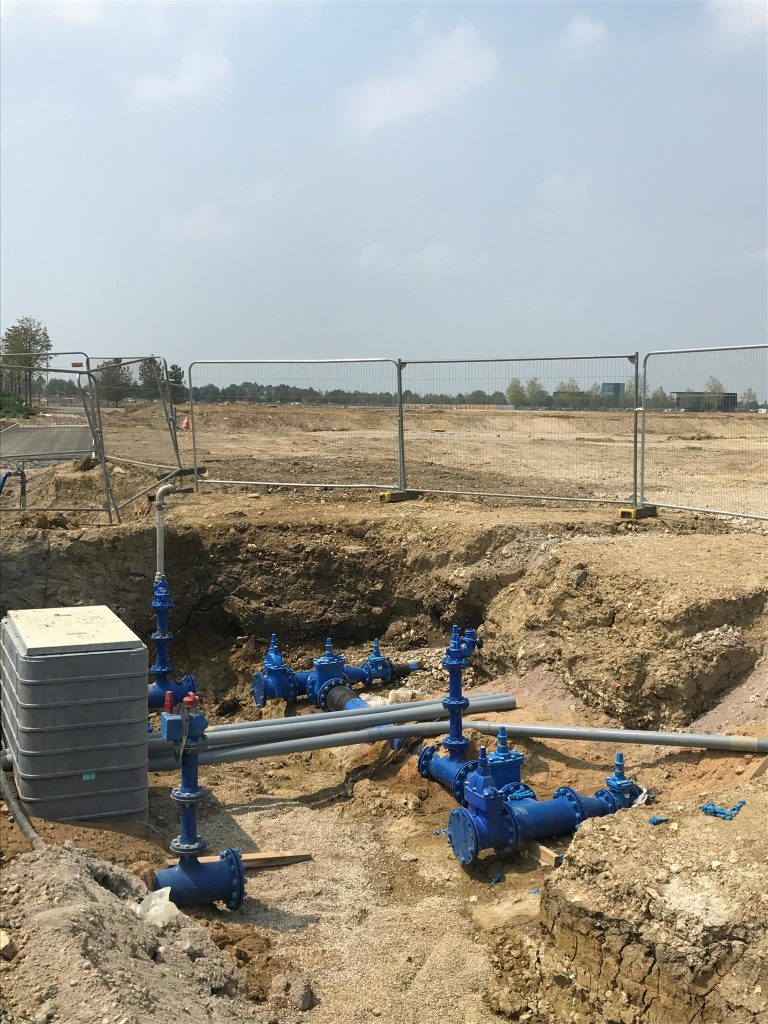
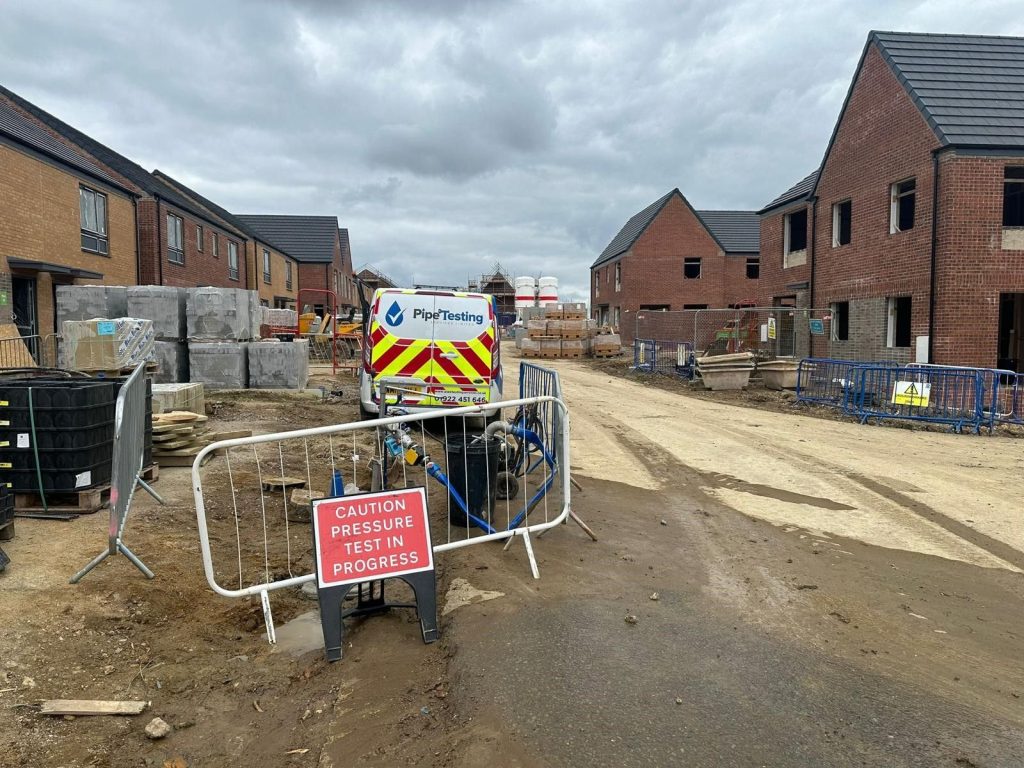
The importance of verifying infrastructure capacity is best illustrated by major developments. At the Alconbury Weald project, a massive new community undergoing construction, ensuring the integrity of the water network was paramount.
Pipe Testing Services was commissioned to undertake extensive pressure testing across the site. On a project of this scale, validating that the mains supply meets the design criteria prevents costly retrofits down the line. Our work ensured the network was robust, compliant, and ready to serve the new residents. Read the full Alconbury Weald Case Study.
The PTS Testing Process: From Planning to Reporting
Although every site is different, our testing process follows a proven methodology to ensure accuracy and safety.
1. Static Pressure Measurement
With no water flowing, we record the static pressure at the test point. This provides a baseline. However, static pressure alone is misleading, a main can show high static pressure but collapse under load. This is why the dynamic element is essential.
2. Step-Test of Flow vs. Pressure
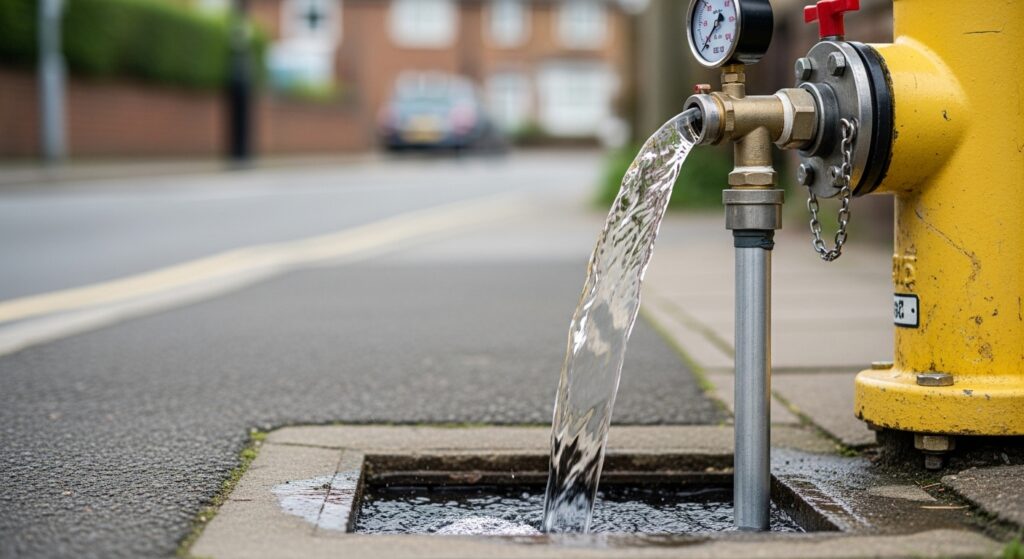
This is the core of the test. We draw water off at a series of increasing flow rates using a controlled test rig. At each step, we record the dynamic pressure. Plotting this relationship creates a performance curve that shows exactly how much the pressure falls as demand increases.
3. Data Logging and Monitoring
For complex schemes, we use digital data loggers to monitor the supply over an extended period (e.g., 24 hours). This identifies time-of-day variations, such as pressure drops during morning peak usage, which could critically affect your system’s performance.
Using Test Data to Size Your Systems
The data from a flow and pressure test is the foundation for sizing two critical building systems.
- Booster Sets and Storage: The test results inform the required pump head to reach the highest outlets and determine if a break tank is needed to buffer the mains supply. If the mains cannot support your peak demand directly, storage is the only solution.
- Fire Safety Systems (BS 9990): For fire mains and sprinklers, adequacy is non-negotiable. Our test validates that the mains can support the high flow rates required for firefighting. If the supply is found to be inadequate, you have the evidence needed to specify dedicated fire pumps and tanks.
Beyond the Adequacy Test
Once the capacity of the supply is confirmed, the physical infrastructure must be verified.
- Pipeline Integrity: If you are installing new rising mains to connect to this supply, they must be proven leak-free. Our Rising Mains Pressure Testing service provides the necessary hydrostatic test certificate.
- System Hygiene: Before the new system goes live, it must be disinfected. We provide full Chlorination Services to ensure the water quality meets UK standards.
- Future Maintenance: To ensure the long-term health of your assets, we offer Clean Water CCTV Surveys to inspect the internal condition of pipes and identify any developing issues.
Don't Design in the Dark
Treating mains water adequacy as an assumption is a risk you don’t need to take. A professional flow and pressure test provides the hard data you need to design with confidence.
Contact Pipe Testing Services today to arrange a comprehensive adequacy test for your next development.
- Phone: 01922 451646
- Email: enquiries@pipetestingservices.co.uk
- Address: Unit 27 Birchbrook Industrial Estate, Shenstone, Lichfield, Staffs, WS14 0DJ
FAQs: Flow and Pressure Testing
Do I need a test if the water company has given me pressure figures?
Yes. Utility figures are often indicative or based on theoretical models. They rarely reflect the exact conditions at your specific connection point or time of day.
Can a booster set fix a poor mains supply?
A booster set can increase pressure, but it cannot create flow. If the mains supply is fundamentally undersized (e.g., a small diameter pipe), a booster set may simply cavitate or trip.
Is this the same as rising main pressure testing?
No. A flow and pressure test checks the capacity of the supply. Rising Mains Pressure Testing is a hydrostatic strength test to check the integrity (leak-tightness) of the pipe itself.